
Announcing the Thunderdome Conference 2026!
Come teach and learn with me in Boulder this summer

Hi there!
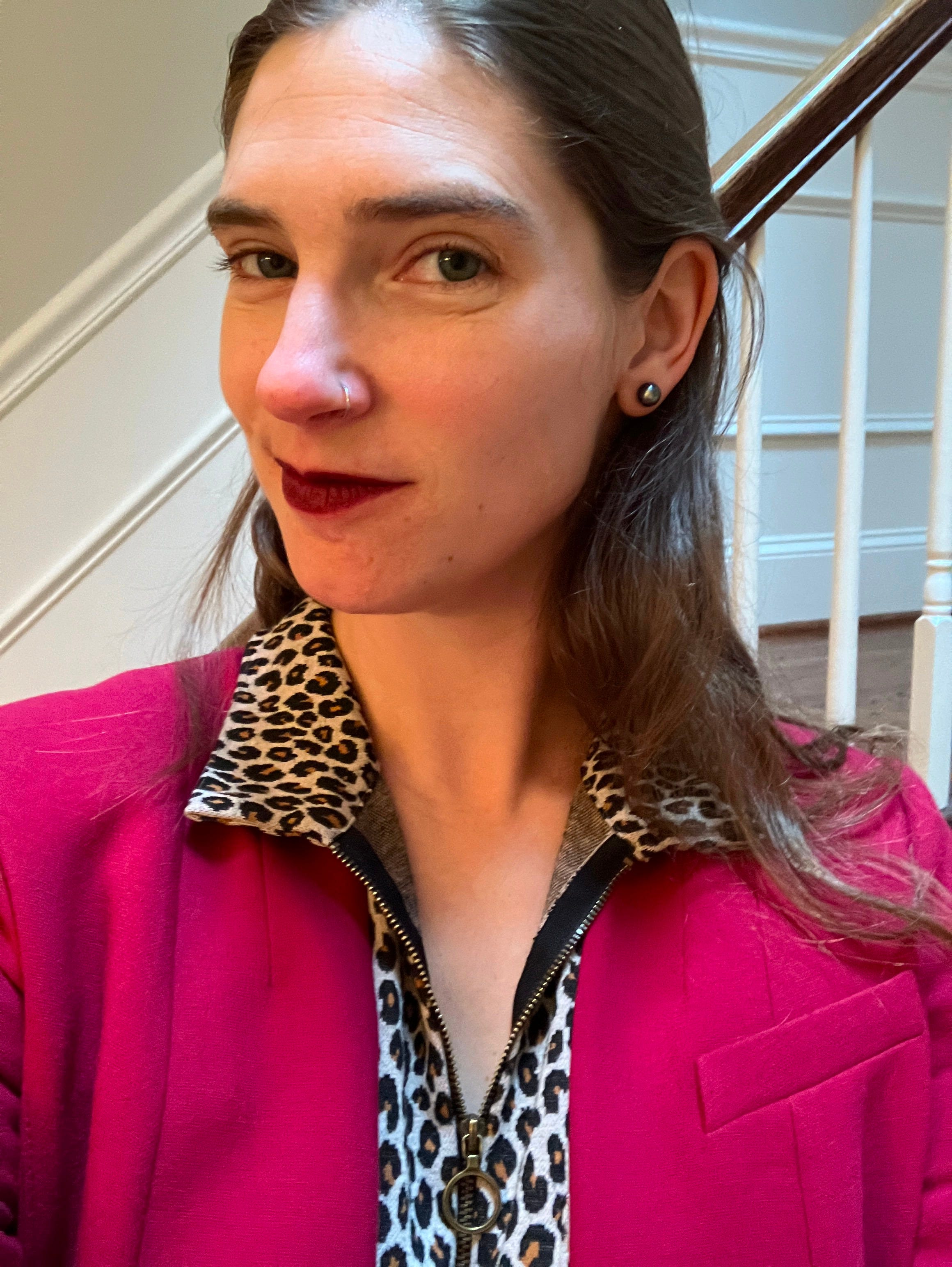
I’m McKenzie, the writer, artist, and critic behind Critic-at-Play. I’m also the founder and host of the Thunderdome Conference: a small-scale residential conference for writers eager to learn from one another.
Is that you? Do you want to stay up late around a campfire dissecting the nuances of your favorite short story collections? Do you want to get into the nitty-gritty of essay structure, point of view in personal narrative, or the architecture of fiction at different lengths?
Do you want to spend three nights at a private conference campus in Boulder, Colorado, eat good food, take in craft talks on a breezy back porch, and maybe squeeze in a local comedy show?
Well then YOU should apply to the Thunderdome Conference!


When I started my low-residency MFA in January 2021, attending zoom lectures and group workshops from the desk in front of the living room window in my apartment in Houston, I didn’t expect to make friends. I had been writing daily for the past decade and a half, and I had never had writer friends. What might “writer friends” offer me?
Other facts from that time: I had almost never published anything.1 I had blogged for about a decade without developing any traction, and I had never submitted to any literary magazines because I didn’t know what literary magazines were.
I’m not suggesting a direct equivalence between having writer friends and finding one’s footing in the literary-publishing-scene/hellscape.2 But I am suggesting some kind of relationship.
I don’t want to mean that in a gatekeeping, pay-to-develop-connections-to-an-elite-ring-of-people-in-power kind of way. What I mean is that I have learned an inestimable amount from developing mutually supportive peer-to-peer relationships with other people who have made writing part of their way of life. It’s not like these friends have automatically extended opportunities to me simply because we share an alma mater and paid the same fees. Rather, we have learned together how to craft artist statements, we have given each other feedback on work samples and pitches, we have swapped notes on great opportunities and which outlets to avoid. They are the ones who have taught me about small presses and the intersection of storytelling and medical narratives, the ones who have taught me about radical publishing tactics and who embody literary citizenship and know how to champion one another’s work.
It is a material reality that connections can lead to more opportunities. This is the basis of networking. It becomes problematic when that networking and those opportunities are locked behind some kind of unscalable paywall, exclusively accessible to those with a class- or prestige-crane to winch them up and over.
For these reasons and others, I launched the Thunderdome Conference: a small-scale residential conference for writers eager to learn from one another. The Thunderdome happens late summer at a private conference campus in Boulder, Colorado, where up to ten writers stay on-site for four days of craft talks, a public reading, local excursions, and generative writing time. The Thunderdome is rooted in a belief that everyone has something to offer, so all writers attend in the position of faculty-participant. In practical terms: everyone who attends presents their own lecture, and attends everyone else’s. (On the topic of opportunities and connections, this also means that everyone who attends can list “faculty for the Thunderdome Conference” on their cv.)
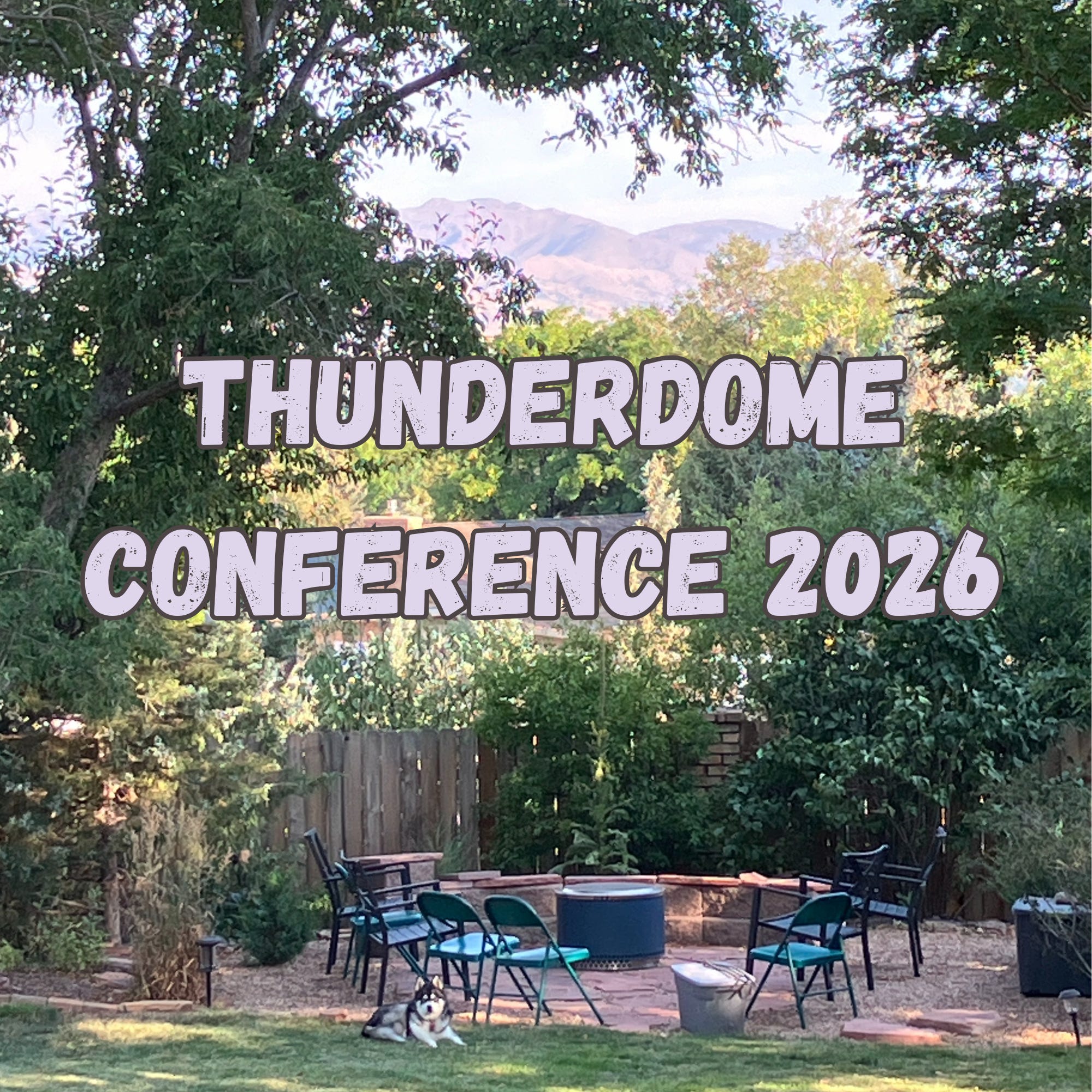
Because the Thunderdome is committed to a vision of accessibility, I strive to keep costs as low as possible. This year’s going rate is $650, housing included. Rooms at the private conference campus are shared and meals are a mix of catered and home-cooked. I also have select scholarships available.
Last year was the first year of the Thunderdome Conference and it was a dream. Faculty-participants flew into Colorado from all over the country: from Portland, Oregon, to Baltimore, Maryland. One of our sponsoring companies provided us with bespoke chocolate bars wrapped in a poem. Faculty-participants delivered craft talks on topics ranging from the divided self in memoir to the architecture of horror.
Thunderdome faculty-participants have attended the Tin House Writers Workshop, the Macondo Writers Workshop, the Carolyn Moore Writing Residency, the Dirtbag Fellowship, and more. They have published work in the Sewanee Review, Barrelhouse, Roxane Gay’s the Audacity, Newsweek, the American Journal of Obstetrics and Gynecology, Electric Literature, the Rumpus, and elsewhere.
And now, I’m looking for YOU! Are you interested in a (relatively) low-cost, high-tier writing conference experience? Are you obsessed with a niche element of craft or have a particular strain of knowledge to share? Do you want to deepen your curiosity in conversation with other artists and writers?
Since the conference is small-scale AND residential, I will be vetting candidates for relevance of lecture topic as well as for group dynamics. I am hoping to curate a diverse cohort that represents different genres, perspectives, and experiences. Depending on how many applications I receive, I may or may not conduct follow-up interviews by phone or video.
Expectations, approximate itinerary, and additional details can be found on the website. Feel free to reach out to me with ANY questions, qualms, or squeals of excitement. And I hope to see your applications soon!
The only thing I had published (outside of my personal blog) at that point was a pandemic-era essay about my husband’s late grandmother. Thank goodness I shared it with an art criticism outlet and not a literary magazine because it has since come to my attention that ‘dead grandparent essay’ is a totally saturated category. That being said, the essay is also a riff on the classic Texas bluebonnet painting, art as a form of placemaking, and gender expectations. You can find it here: https://glasstire.com/2020/09/09/expecting-bluebonnets/
And I definitely don’t consider any of these benchmarks to be authoritative measures of success, because “success”—especially in terms of creative pursuits—is both elusive and subjective.