
Taking the Tradwives Seriously
On the discourse around Yesteryear

For a while, I wasn’t paying any attention to the Yesteryear discourse. Tradwives aren’t my beat—which is weird, because the female experience within religious contexts and communities is my beat, but somehow, I’ve never been particularly fascinated by tradwives.
Allow me to clarify: I’m interested in the female experience of religion WITHIN the context of mainstream culture—the religious subculture that operates at the fringe, the margin, of popular culture at large.
I’m not particularly interested in extreme fundamentalism, sectarianism, separatist communities. Rather, I’m interested in the uncomfortable overlap: the spaces where girls and women were taught to be ‘in the world but not of the world.’
I’m interested in this experience because it’s my own. My upbringing was not fundamentalist, but it was conservative evangelical. My parents supported Focus on the Family and Chuck Swindoll’s Insight for Living, but somehow avoided the Debi Pearl and Bill Gothard schools of parenting (IYKYK). I am constantly trying to quantify the strange quotient of ‘normalcy’ I experienced: I attended public school, but mine was a ‘values-driven’ public charter school run by a board of Christian moms. I watched the Office but never the Simpsons. I participated in high school theater, but after rehearsal, most of my theater friends carpooled to midweek youth group. My parents let me host parties in the basement, but my friends and I spent those parties playing card games and going to the local playground to play groundies, not getting drunk or spinning bottles.
I am interested in the normalization of conservative Christianity—partially because the powerful Christian factions pretending at separatism are the same ones that have slowly been accruing greater and greater power in Washington. The more their tactics and values are normalized, the less resistance they face. The same Christian groups who claim to want nothing to do with the world are actually the ones working so hard to remake the world—specifically, the United States of America—in their own authoritarian, patriarchal, white supremacist image. (If this captures your curiosity, check out Tim Whitaker’s recent deep dive on the New Apostolic Reformation, or my recent essay for MAYDAY about Christian Nationalism.)
Maybe that’s why I’m not overly interested in the tradwife conversation. Plus, I don’t know that much about it—it’s not my lane. There’s a dangerous flattening that comes from conflating all religious participation with fundamentalism and all church involvement with cults. Identifying everything with its most extreme expression is another kind of binary thinking that ignores nuance and squelches critical engagement.
So I’ve heard about Yesteryear. I haven’t read it. But I have been reading the reviews of it, and I have been surprised and gratified to find a melody threaded through the discourse that harmonizes with something I’ve felt for a long time.
In Leigh Stein’s review of Yesteryear, she identifies what disappointed her about the novel: Caro Claire Burke(CCB)’s lack of serious inquiry into the context in which she sends her protagonist.
Stein writes, “Caro Claire Burke didn’t think it was necessary to bring any research into the novel about what it was like for women homesteaders in the American West in 1855. She wasn’t curious enough to learn what “chores; chores; chores” actually entailed; . . . Burke doesn’t seem to find women’s domestic labor very interesting.”
Whether it’s domestic labor or religious devotion, readers and reviewers consistently take issue with the lack of granularity in CCB’s portrayal of her protagonist, Natalie. Burke has presented an idea of a character that she never fully inhabits. Furthermore, the fact that she thought she could present such a blurry-edged character in such a major book reveals what I’ve suspected for a long time: religious experience is not taken seriously as a subject in mainstream contemporary literature.
When women of religious persuasion or commitment are depicted in popular media or literature (and even for such women to appear is fairly rare), they are often not shown with empathy but with a kind of exoticised fascination.
Yesteryear seems to deliver more identitarian bewilderment than narrative development: who does one have to be in order to be like this, rather than, how did you get here?
The implicit response to the question ‘who does one have to be’ is the answer, someone completely unlike myself. The author apparently cannot compassionately envision herself in the shoes of her protagonist.
But if the question is, how did you get here, then the implied determinative factor is not identity but circumstance — could something happen that would put me in that same position, too? “There but for the grace of God go I.”
Rafael Frumkin frames it like this: “No matter how much of an “other” I may seem to you, your job as a novelist is not to work inductively – i.e. “What a sad little life this lesbian millennial led! What sort of sad little consciousness might emerge from such a life?” – but deductively: “These are the circumstances of this character’s life, so what’s the consciousness to match them?”
What kind of religious values, commitments, and fears would a character have to have to end up in Natalie’s position? If someone is going to write a book with a religious protagonist, I want them to take that protagonist’s religiosity seriously.
Yesteryear is painfully out of touch with the experiences of religion that it claims to represent.
In the Argument’s review of Yesteryear, Jerusalem Demsas and Maibritt Henkel write, “Perhaps because of her “secular childhood,” Burke does not imagine that faith could play much of an important role in understanding the perspective of women living in religious communities. The word “God” is invoked more times as a curse (“God no,” Natalie laughs when asked about getting plastic surgery) or descriptor (“God-awful quilt”) than as the central figure of any Christian’s life.“
When I read this, I thought, yes! This is one of the problems with so much published writing about religion: religion is depicted as so foreign, so strange and niche, that authors seem to forget (and apparently no one reminds them?) that the religious and the formerly religious may in fact be among their readers.
I felt this way last summer while reading Melissa Febos’s latest book, The Dry Season: Finding Pleasure in a Year without Sex. Febos writes about her experiment with voluntary celibacy as if the idea is completely novel, an approach to sex that hasn’t been invoked since the time of Hildegard of Bingen and the other female mystics Febos so idolizes—when, in fact, the United States has facilitated a pretty major movement encouraging sexual abstinence, partially funded by government dollars and carried out by public schools, colloquially known as purity culture.
When Famished author Anna Rollins posted an Instagram story about editing her book review of The Dry Season, she and I shared a brief text exchange about how disorienting it was to read Febos’s book and to reckon with Febos’s apparent ignorance as to the prevalence of purity culture. Does she not know about the existence of girls like us? Anna and I both seemed to ask.
The Dry Season is a memoir, so one could argue that Febos has no responsibility to comment on movements that do not intersect with her experience. Maybe my frustration was solely self-aggrandizing; I wanted to see more of myself in Febos’s book. But as a memoirist who loves to see a story grounded within a broader cultural context, I’m curious how a nod or two toward purity culture could’ve expanded the scope of the book, could’ve located Febos’s experience of sex, sexuality, and intimacy hunger in a larger cultural conversation.
Secular literature and the secular literary discourse at large don’t consider earnest religious experience worthy of serious consideration. That’s the major misstep that Caro Claire Burke seems to have made.
I am thrilled that Yesteryear has propelled the female experience within repressive religious contexts into the zeitgeist, as seems to occur once every few years. These books, like Yesteryear, tend to be sensationalist, reductive, and lacking emotional nuance. I would include on this list Tara Westover’s Educated and Deborah Feldman’s Unorthodox—not that they’re bad books, just that they’re treated like singular stories of escaping fundamentalist ______ (insert religion here), often without much reflection.
CCB kind of damned herself to a lot of religious (and formerly religious) readers when she said, in an interview with the Rumpus, “I realized very quickly that whether it’s Mormonism or evangelicalism or Jehovah’s Witness, it’s really all the same in terms of how women are treated and what the expectations are for them.”
This is an inherently reductive framing, weakening readers’ capacity to engage in education conversations about the many faces of fundamentalism.
Sure, I have also written about how fundamentalist religious patriarchy can create similar situations of abuse across different religious contexts. There are, as CCB acknowledges, similarities. But asserting that whole categories of religions WITH WHICH ONE HAS NO PERSONAL EXPERIENCE are ‘really all the same’ feels so patently disrespectful. Irresponsible.
The discourse around Yesteryear reveals that believerhood has become illegible to the public at large. At some point, polarization pushed faith past ‘the other side of the (sanctuary) aisle’ and into a realm so foreign it elicits ridicule, not recognition.
In a wide-ranging conversation about Yesteryear in the “2 Girls 1 Book” feature, Pandora Sykes and Ochuko Akpovbovbo interpret Natalie as a protagonist “filled with violent zeal (she is religious, that part isn’t fake)”.
‘That part isn’t fake’? I repeated back to myself skeptically. Why? Because Natalie uses the phrase ‘waterboarded with modernity’? I mean, sure, great phrase, but that tells me nothing about the epistemology to which she adheres.
To be anti-modernity is not necessarily a hallmark of religion, and the fact that that phrase is what convinces Sykes and Akpovbovbo (whose arguments I otherwise find quite engaging!) that Natalie’s religiosity is ‘real’ seems to illustrate the way a caricature of anti-intellectualism and anti-feminism has come to serve as a stand-in for religiosity on the big screen, even when that screen is pulped paper rather than silver projection (and, given the major announcement that Anne Hathaway had bought the screen rights to Yesteryear before the novel was even finished, potentially a relevant conflation).
Meghan O'Gieblyn, a writer who can certainly chronicle the particular interiors of evangelical religious life, writes about her time at Moody Bible College as a place characterized by serious intellectualism, just pointed in a different direction than most of her contemporaries.
If you’re going to give me a protagonist who claims to be defined by their religion, at least let us see them wrestle with that. Give them—and us—the decency of allowing that to be real.
In the review on Vox, Constance Grady also presents Natalie as wrestling with modernity.
But in my understanding, the religio-political steam engine powering the ‘trad’ train, as it were, is fueled more by an affection for retrograde gender roles and religious hierarchies rather than the ignorance of modern technological conveniences. After all, as Burke makes so visible, trad wives have built thoroughly contemporary product lines and media empires with the means of thoroughly contemporary technology.
Are people looking for a tradwife novel or are people looking for a time travel novel? One of the quickest ways that readers go wrong when assessing a book is that they evaluate the book as it is against the book they wanted it to be, rather than the book it was trying to be.
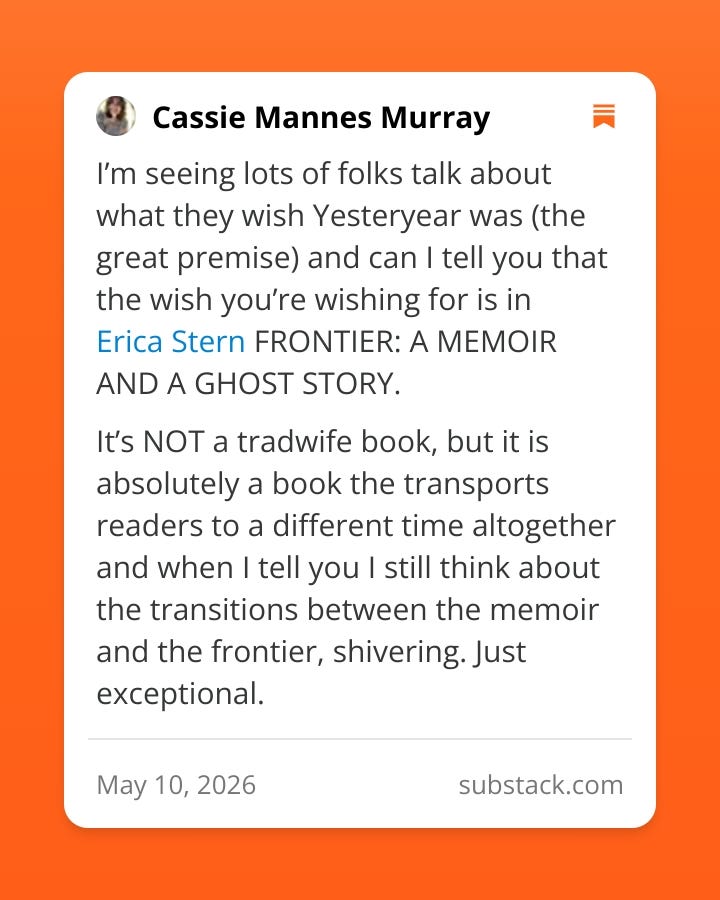
I don’t believe for a second that tradwives are actually yearning for an earlier time. The moniker is a misnomer. At no point has the goal been to travel back in time, but to conjure a false, mythological past, where women are revered at the same time as they are disenfranchised.
I think, in spite of myself, about my mother: a conservative Christian woman who flourished as a stay-at-home mom, who has never felt effective in an office, who shamelessly idealizes the homesteaders and pioneers who settled this land (and participated in displacing and genociding the indigenous people who lived here before them). She is a twenty-first-century woman who doesn’t really get feminism. It’s not that she hates feminists, or views them as working toward something evil. It’s just that . . . she doesn’t really see what all the fuss is about. So what if all the pastors of her church are men and she spent years working as the assistant children’s programming director reporting to a six-and-a-half-foot tall man with a bad temper named John? She wouldn’t have wanted to be a pastor anyway. She’d rather make crafts with the kindergarteners.
My mom is the antithesis of Natalie, CCB’s seething, embittered protagonist.
In the Vox article, Grady continues, “Throughout the novel, characters create an imaginary woman out of scraps of social media content, just so that they can get mad at her. Natalie does it with Reena, and Natalie’s followers do it to her. In Burke’s telling, we do this because we are all unhappy with our own lives and want to lash out. Which is a little strange, because what is the novel Yesteryear if not the process of creating an imaginary woman out of scraps of social media content, just so that we can get mad at her?”
Grady names the hypocrisy of the novel about social media hypocrisy: that to deny Natalie her own beliefs is to rob the premise of its power.
That being said, I’ve also noticed aspects of commentary that seize upon Natalie’s identification as a ‘Good Christian Woman’ who does not attend church or practice any form of visible devotion as possibly emblematic of the most dangerous forms of Christianity today—forms of religiosity that have coalesced into an identity devoid of accountability and commitment, a cultural alignment without any ideological guardrails. These are the ‘Creaster’ Christians who only attend church on Christmas and Easter, cultural Christians who claim Christ but still curse at the car one lane over in traffic, or use the c-word like Natalie does. For a comparative benchmark: I’m personally quite fond of expletives, and my Christian parents recently asked me to tone down the swearing while I’m in their presence. Christians like Natalie might identify as ‘evangelical’ in a Pew survey and also unquestioningly support Trump. This is the ambiguously affiliated evangelical of the Trump era. In Jesus and John Wayne, historian Kristin Du Mez writes about the messy lack of definitional criteria, explaining,
“What it means to be an evangelical has always depended on the world beyond the faith. In recent years, evangelical leaders themselves have come to recognize (and firmly lament) that a ‘pop culture’ definition has usurped ‘a proper historical and theological’ one, such that today many people count themselves ‘evangelical’ because they watch Fox News, consider themselves religious, and vote Republican.”
The lack of particularity in books like Yesteryear is actively contributing to the erosion of shared cultural language for discussing Christianity and fundamentalism.
I want to root for Caro Claire Burke (where did the framework of competition come from?). Her article for the Guardian about tradwives, “Serve, Smile, Procreate,” is smart and biting. CCB references how there is a singular continuum that stretches from viral tradwife content to the ICE raids and murder of Renee Good, and I agree with her. But there are so many interim steps that also bear addressing.
In Ginny Hogan’s rave review for the Cut, she describes feeling full access to Natalie’s interiority. Maybe this is in contrast, Hogan admits, to the caginess of real tradwives, the ones on which Yesteryear is allegedly modeled, the ones from which their colossal audiences only ever receive immaculately produced content and never off-the-cuff cursing or furious inner monologues. With that comparison at the forefront of Hogan’s review, her appreciation for what she interprets as the fictional Natalie’s transparency is a little more understandable.
But there’s one paragraph in Hogan’s review that gave me pause.
“The real-life tradwives would never let us see what compromises they’ve made . . . There’s never an acknowledgement that they’re cosplaying Betty Draper because they have no other choice, because other doors had shut behind them.”
Hogan juxtaposes the fictional Natalie’s ‘transparency’ with her ‘censoriousness’ around what she has lost, or sacrificed—in the words of Maryellen Groot, “what she has had to amputate in order to become herself.”
Ever so subtly, Hogan implies that one would only choose the tradwife life (‘choice feminism’ is a major aspect of the discourse surrounding Yesteryear) if they had no other options—and a choice made under duress is hardly a choice.
Again, I want to return to circumstance, to the empathy of imagination that asks, ‘how did you get here.’
This is where I hope to remind readers that all choices are made within specific contexts. None of us truly have access to infinite opportunities at once. All of us have experienced the closure and opening of different doors in our lives.
For example: if I had found a godly man at Christian college who’d actually liked me at the same time as I liked him, I’m not sure I would be writing this essay right now.
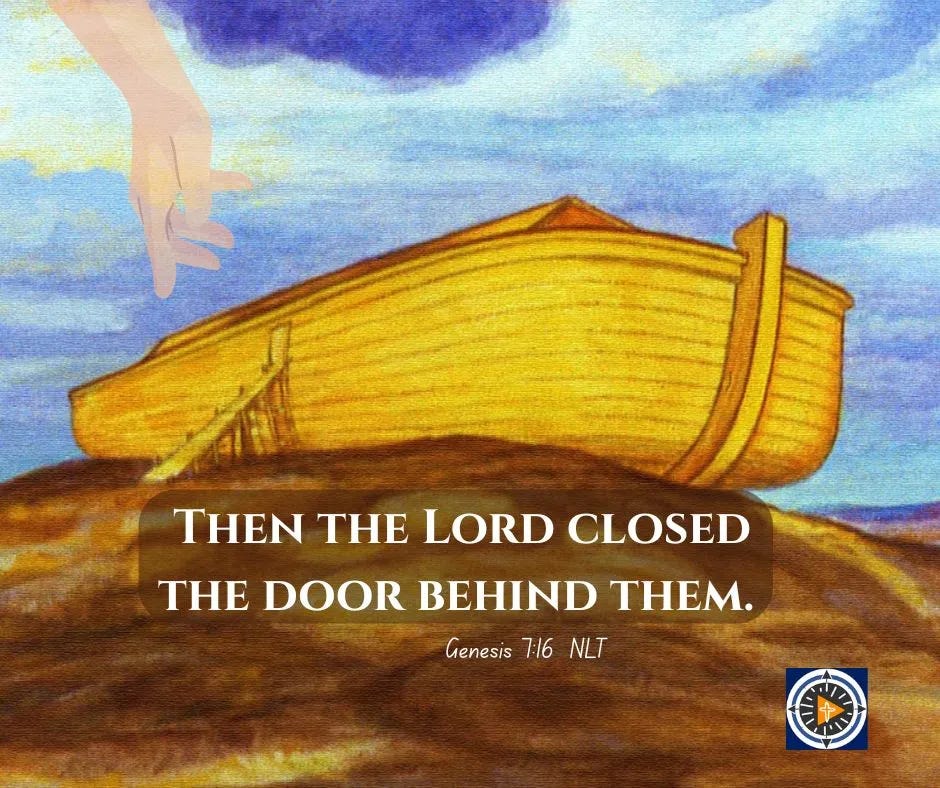
When Hogan writes of the tradwives, “there’s never an acknowledgement that . . . other doors had shut behind them”—for how many of us is that true?
Reading the reviews of Yesteryear made me wonder about our collective capacity to imagine people fueled by motivations other than our own. Has the breakdown of the social fabric and the intensification of our echo chambers deposited us in a place where we cannot fathom an ‘other’ who is not made in the image of ourselves? Where we are more likely to interpret someone different from us as fraudulent rather than simply unfamiliar?
In God, Human, Animal, Machine, former evangelical turned tech writer Meghan O’Gieblyn uses the alleged prevalence of internet bots to examine the challenge of conceptualizing the other. This is a big block quote, but it’s been sizzling in my brain for weeks.
“The problem is not merely that public opinion is being shaped by robots. It’s that it has become impossible to decipher between ideas that represent a legitimate political will and those that are being mindlessly propagated by machines. This uncertainty creates an epistemological gap that renders the assignment of culpability nearly impossible and makes it all too easy to forget that these ideas are being espoused and proliferated by members of our democratic system—a problem that is far more deep-rooted and entrenched and for which there are no quick and easy solutions.”
How do we reckon with the reality of people whose behavior and allegiances we cannot predict? What do you do when the other has become incomprehensible, unimaginable, to you?
Well, if you decide to write a book about that unimaginable other, you better start doing some serious research.
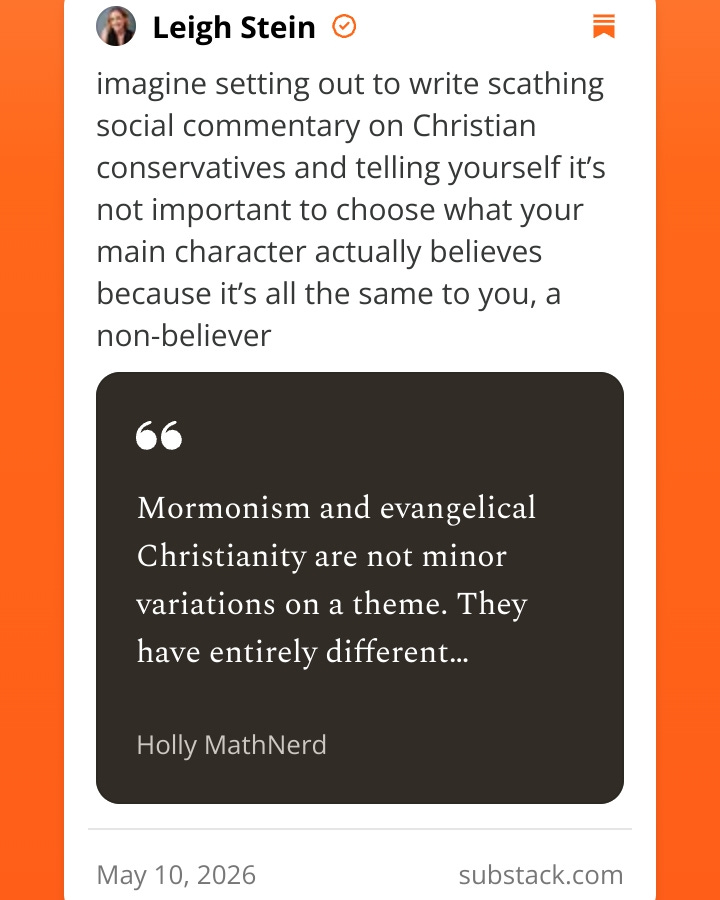
Holly MathNerd, in her so-hot-it-burned-my-hands review of Yesteryear, makes a fantastic point about CCB’s self-described research methods, which involved talking to Mormon and evangelical women and lurking on forums for people who left.
Holly writes, “Burke’s primary corpus for understanding fundamentalist Christian womanhood was deconversion narratives — testimonies from women who left. This is, to be fair, a rich and important body of material. I have read a great deal of it and written some of it. But it has one structural feature that matters enormously for what Burke was trying to do: the narrator has, by definition, left. The frame is retrospective. The interpretive lens is “here is what was wrong with the thing I was inside of.” It is an excellent corpus for understanding the experience of leaving. It is a terrible primary source for ventriloquizing a character who is, per the conceit of the novel, still in it and sincere about it.”
This reiterates, yet again, the dearth of legitimate representation of religious women—and it brings me back to original point that instigated this (now very long) essay:
When I started formulating these thoughts in a Substack note, I said that the mainstream literary treatment of women’s religious experiences is so often over-marketed and under-considered, while the people writing with intimate knowledge of religious dynamics and communities are often seen as too far outside the mainstream to comment.
As a literary critic who specializes in covering books about religious identification, experience, and communities, and the intersections of religion and culture, I’ve repeatedly had trouble placing reviews because literary magazines don’t consider the books I’m reviewing to be relevant, or they won’t touch work from ‘religious’ presses.
How are we supposed to engage in rigorous conversations about culture if so many people insist on ignoring and minimizing the role of religion?
I have written elsewhere about the apparent chasm between secular and religious literature and how I have trouble finding my own footing somewhere in between these two cultural worlds. I long for greater overlap, more conversation between the two. I want more mainstream readers to find the work that showcases the endless variations within religious experience, its irreducible complexity.
There is good — nuanced, textured, thoughtful, rigorous — work out there about the nuances of religious and post-religious experience!
For example, Tia Levings’s memoir, A Well-Trained Wife, gives readers an intimate glimpse into the far-from-romanticised life of being a submissive fundamentalist Christian wife. Levings also traces her journey from ‘normal’ teen girl to being a mother who wore shapeless denim jumpers and re-used toilet paper to eventually fleeing her abusive marriage and repressive fundamentalist community. A Well-Trained Wife captures Levings’s motivations, her missteps, and her very human arc from a position many of us can relate to—that of being a teenage girl at church—to a position—tradwife and survivor of domestic violence—that is hopefully far less familiar. Levings (whose sequel, I Belong to Me, came out last week!) writes with lived experience from within the phenomenon.
As I wrote about two weeks ago, Stephanie Stalvey’s breathtaking graphic memoir, Everything in Color, just came out. I also cherish the work of Addie Zierman, Anna Rollins, Liz Charlotte Grant, Sara Moslener, martha park, Sara Triana, and so many others. (If I didn’t name you and you write in this space, it’s not an intentional exclusion! I’ve just been working on this essay for . . . so many hours . . . and it’s late.)
Have you read Yesteryear or the reviews of it? What lands for you, and what feels alienating? Do you see yourself in portrayals of religious or religious-adjacent characters, or do they feel fraudulent?
Who are the writers you turn to for portrayals of religious experience and religious wrestling? These can be narratives of religious disaffiliation, deconstruction stories, escape memoirs, all of it. There is room for a multitude of stories here.
All of this is so excellent. I'm doing a Yesteryear book club with a friend this summer. We both taught English in higher ed, and we both we were in evangelical culture. I'm very, very eager to have a conversation with her about the flat portrayal of deeply religious women.
I'm so grateful for your voice in this discourse -- it's so necessary!
This is so good! And this part - “I think, in spite of myself, about my mother: a conservative Christian woman who flourished as a stay-at-home mom, who has never felt effective in an office, who shamelessly idealizes the homesteaders and pioneers who settled this land (and participated in displacing and genociding the indigenous people who lived here before them). She is a twenty-first-century woman who doesn’t really get feminism. It’s not that she hates feminists, or views them as working toward something evil. It’s just that . . . she doesn’t really see what all the fuss is about. So what if all the pastors of her church are men and she spent years working as the assistant children’s programming director reporting to a six-and-a-half-foot tall man with a bad temper named John? She wouldn’t have wanted to be a pastor anyway. She’d rather make crafts with the kindergarteners.”
WOW. That is my mom - and honestly, most of the women I knew growing up.