
Marking the Day
What if we are the only archive we have?

I was going to run an essay about how the novel Piranesi is a religious deconstruction story, but today is January 6th, and in light of recent events, I want to acknowledge that and what it’s bringing up for me.
I remember exactly where I was on 9/11. I was a third grader in Colorado; my dad was on a trip to Scotland and my mom was home with my brothers and me. My parents kept a ten-inch tv in their bedroom and I remember watching it that morning before school: footage of the Towers falling, the plane ramming into glass. I remember the newspaper printed a color photo that took up the entire first page along with a headline about the face of the devil in the fumes.
9/11 immediately became one of those American days “which will live in infamy” —a phrase President FDR uttered in regards to Pearl Harbor at the end of 1941—a day in which American democracy was assaulted.
Which is to say, in the words of poet Franny Choi: “The World Keeps Ending and the World Goes On.” This sense of panic, decline, the comingled fear and thrill of feeling like one is at the end of history—none of this is new.
//
I remember exactly where I was on January 6, 2021. I remember the cream-colored tint of the walls in the home office where I’d spent most of 2020, cooped up during the lockdowns. I remember watching footage on my laptop, checking headlines. My brain couldn’t assemble the information my searches dredged up; I wasn’t clear on what was happening.
You don’t need me to give you the summary, but I will1: after a “Save America” rally in downtown DC, Donald Trump invited his followers to join him in marching toward the Capitol. Near the Washington Monument, hundreds of Proud Boys had already gathered and were also marching. The Capitol was breached shortly after 2 pm.
Ostensibly, this happened because Joe Biden had been named the winner of the presidential election, and the rioters were looking for Mike Pence in order to keep him from ratifying the election results. But in a broader sense, this was a demonstration of grassroots political power solely in service to Trump: not to the Constitution, to the peaceful transfer of power, not to the idea of democracy (however flawed its implementation) or the rule of law. January 6th is when the whole country watched the incarnation of white anger and entitlement seek to enact its own political aims by force.
Once the Capitol was breached, rioters surged through the hallways, looking for Mike Pence, Nancy Pelosi, and other members of Congress. A gallows was erected outside and chants of “Hang Mike Pence” rang out in the hallways of our country’s highest buildings.2
At least five people died during the riot, PBS reports, including insurrectionist Ashli Babbitt, who became a kind of martyr for the cause. Around 1,500 people were eventually charged in the Capitol Attack.
But in the five years since then, the United States government hasn’t figured out how to respond to this event. In part, this is because Donald Trump has been returned to power. Within hours of taking office in 2025, he pardoned everyone who had been charged in relation to January 6.3
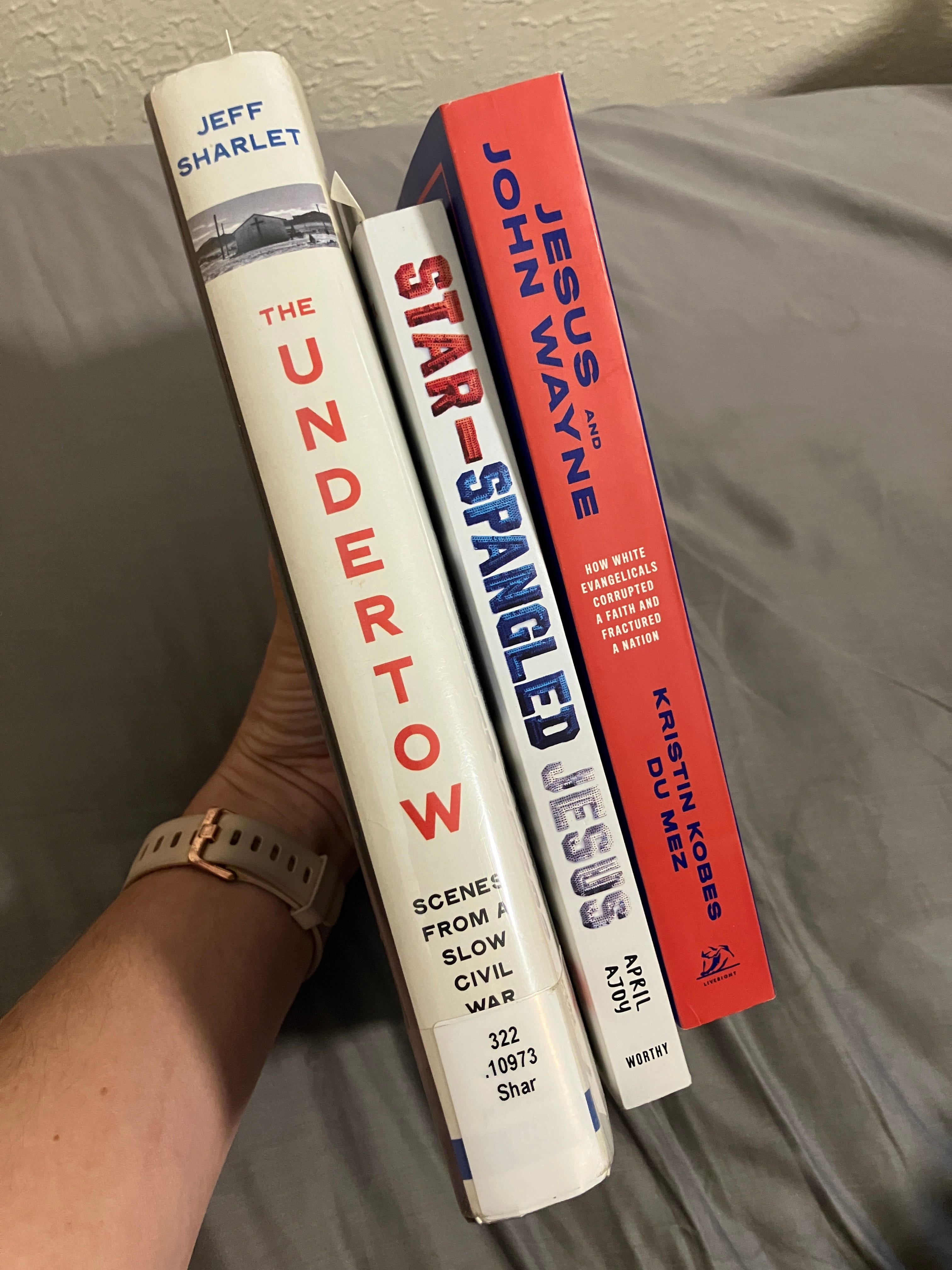
If I had to recommend only one text that touches on the events of January 6th and their ripples throughout American culture, it would be Jeff Sharlet’s The Undertow: Scenes from a Slow Civil War. In the titular essay, he attends the funeral of Ashli Babbitt, and then drives across America, conducting conversations to better understand the grassroots movement that supports Trump at all costs, that thrives on the theories of Q-Anon, that is arming itself and preparing for conflict. (I’ll have an essay out from Mayday magazine sometime this spring looking at The Undertow in greater depth, alongside April Ajoy’s Star-Spangled Jesus: How I Left Christian Nationalism and Found a True Faith.)
But history keeps going. The other night I watched a youtube video of a Josh Johnson comedy segment about the Vanity Fair photoshoot at the White House, and already that feels like old news. On the third day of this year, Americans woke up, checked our phones, and saw that the Trump administration had invaded Venezuela overnight and abducted its president and his wife.4
Again, I don’t need to tell you any of this. You already know it. If you’re reading this, you’re not in a position to escape the news—but you’re also not likely in a position to really internalize any of it, because it’s all happening at once and how can any of us process all of this while also paying our bills and tending to our households and trying not to lose our minds??
The distraction is part of the point. The overstimulation is meant to wear us down and make us numb.
We are still waiting on the Justice Department to comply with Congress’s Epstein Files Transparency Act.5 I want the unredacted files to be released because I want to believe in justice, because I want to believe that there are people in power who actually care about protecting the vulnerable and responding when horrific things have been done to them, and I also don’t believe in the carceral system, and I think if we believed the word of survivors we wouldn’t have to act like the “Files” are all the evidence we have.
We are six days into a new calendar year.
We have not yet hit the one year mark since the inauguration of Donald Trump’s second term as president.
Last month, Franklin Graham—son of the late Billy Graham, one of the most famous evangelists of the past century, and an early evangelical supporter of Trump—delivered a Christmas sermon in the Pentagon before Pete Hegseth and others. In that sermon, Graham preached that God hates, and “God is a god of war.”6 We are descending into an abyss of ideological polarization that I don’t even know how to wrap my mind around.
In an essay for the New Yorker that came out last May, Jia Tolentino writes, “The past has vanished, the future is inconceivable, and my eyes are clamped open to view the endlessly resupplied now.” (If you haven’t read it yet, consider doing so. It’s both disorientingly outdated and nauseatingly timely.)
She mentions the genocide in Gaza, which is ongoing, despite less news coverage thanks to the pretense of a ceasefire.7
Tolentino writes, “Many of these news items feel too horrific to be true, except that they are true, although they are reported in media outlets that many Americans refuse to believe, and appear in news feeds alongside a wide variety of things that are obviously false—or, maybe even more treacherous, weirdly indeterminate.”
Political commentary is definitely not my wheelhouse, but I’m writing this because it is vital for us to be our own archives these days. It’s up to us to determine what matters and where, amidst the surges of slop and the tides of misdirection, we should allocate our attention.
Your attention is a precious resource. Thanks for sharing yours with me.
I’d love to know:
What stands out to you now as you remember the events of January 6th?
What are your favorite written resources that reference January 6th? And what do you appreciate about them? (News articles, op-eds, think pieces, full-length books: hit me with your recs)
The insurrection—like the election of Donald Trump in 2016—was a major illustration of American evangelicalism’s alignment with Trump. How does the alliance of these forces appear to you?
Additionally, see NPR’s Visual Archive.
See: “Pence was 40ft from Mob on January 6,” by Martin Pengelly, via The Guardian; https://www.theguardian.com/us-news/2022/jun/16/mike-pence-40ft-from-mob-january-6
See: “A January 6 Plaque Was Made to Honor Law Enforcement at the Capitol. Its Whereabouts are Unknown,” by Lisa Mascaro, via PBS; https://www.pbs.org/newshour/politics/a-jan-6-plaque-was-made-to-honor-law-enforcement-at-the-capitol-its-whereabouts-are-unknown
To learn more, check out Nicole Cardoza’s ReImagined newsletter. You can find her latest coverage of the situation in Venezuela here: https://reimaginednews.beehiiv.com/p/what-to-know-about-venezuela
See: “Slow Epstein Files Release Not as Concerning as Docs DOJ Has Withheld,” by Michel Martin, via NPR WUSF; https://www.wusf.org/2026-01-02/slow-epstein-files-release-not-as-concerning-as-docs-doj-has-withheld-says-ro-khanna
See: “Franklin Graham Preaches a God of Hate,” by Brandon Ambrosino, via Christian Century; https://www.christiancentury.org/online-columnists/franklin-graham-preaches
See “The Ceasefire Did What It Was Meant to Do – Make Gaza Invisible,” by Eman Abu Zayed, via Al Jazeera; https://www.aljazeera.com/opinions/2026/1/2/the-ceasefire-did-what-it-was-meant-to-do-make-gaza-invisible
One of the things that strikes me about Jan. 6 that I have never seen much commentary on is how much of it resembled performance art. I am thinking about the costumes, body adornment, ritual beatings of capital police, folks showing up in tactical gear they couldn't possibly realistically make use of, the gallows, the takeover of Pelosi's office (complete with feet propped on the desk), etc. The actions were intended to achieve a particular result, which failed, but much of it was not very strategic; what was done was also intended to MEAN something. It was a form of communication. What, one wonders, does this say about the meaning structures of the rioters, and the many folks watching at home who celebrated their art and felt represented by it? Who cultivates and promulgates this aesthetic? If some legitimate disgruntlement fuels it but has been co-opted by nefarious actors, how can aesthetic work be done to take back some of that ground in the public discourse, and art be furnished for public viewing that responds to some of the same hurts and hungers in ways that are, in the end, constructive?
This is such an interesting thought! All the more resonant in the age of social media and the fact that this was the most well-documented (most of it by protestors/insurrectionists) events of its kind in modern history.
That, combined with the thought that performance art can allow for ritualization of feelings without, say, threatening to literally hang the vice president. Makes me think of Okwui Okpokwasili and her performance pieces that explore the nigerian para-governmental practice of « sitting on a man’s head »
So much to mull over!